
BLOG
What Is a Wood CNC Router? What Can You Produce with a CNC Router?


What Is a Wood CNC Router?
A wood CNC router is a computer-controlled machining system designed to cut, shape, carve and drill materials such as MDF, plywood, solid wood, composites and plastics with high precision.
Using G-code instructions, the spindle and cutting tools move along the X-Y-Z axes, allowing both 2D and 3D operations.
With the right tooling, vacuum table and cutting strategies, a CNC router offers:
- High accuracy
- Consistent repeatability
- Fast production
- Minimal waste
- Clean surface finishes
This makes it one of the most efficient machines for modern furniture and interior production lines.
Main Components of a CNC Router
✔ Rigid frame & motion system
Steel chassis, linear guides, ball screws or rack-and-pinion.
✔ Spindle
Air-cooled or water-cooled, selected according to cutting needs.
✔ Tool changer
Manual, semi-automatic or ATC (automatic tool changer).
✔ Vacuum table / fixturing
Holds sheets firmly for clean, vibration-free machining.
✔ Electronics & control
Control panel, servo drives and CAD/CAM integration.
What Can You Do with a CNC Router?
1) Cabinet doors & decorative panels
Shaker, raised panel, country, soft-edge profiles, handle-less door pockets.
2) Cutting / nesting
Optimized layouts to maximize sheet yield and reduce offcuts.
3) 3D carving & relief patterns
Motifs, ornaments and artistic designs.
4) Drilling & grooving
Shelf pin drilling, minifix, back groove, decorative lines.
5) Surfacing & leveling
Flattening warped solid wood panels.
6) Mold & jig making
Prototypes, MDF/PU foam molds.
7) Acrylic & composite machining
For signage, fair stands and decorative components.
8) Doors, bases, furniture components
Efficient multi-part nesting for scalable production.
Tip: With a vibration-free structure and strong vacuum table, Makser RO66 CNC Router minimizes tool marks and reduces the need for additional sanding.
Right Tooling & Cutting Strategy
✔ Tool selection
Upcut, downcut, compression bits, ball nose, V-carve, straight flutes.
✔ Feed–speed balance
Correct chip load improves tool life and surface quality.
✔ Cutting depth
Multiple shallow passes reduce vibration and improve edge quality.
✔ Material holding
Vacuum zones, auxiliary fixtures for small parts.
✔ Dust extraction
A high-efficiency dust hood keeps the surface clean and safe.
Common Applications (Examples)
- Membrane door pre-processing
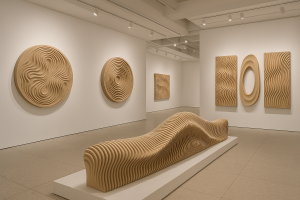
- 3D/2.5D decorative wall panels
- Acrylic & PVC foam board for advertisement
- Custom furniture: tables, TV units, children’s room sets
- Chair legs, bed parts and door machining
- MDF relief and mold production



Maintenance & Safety
Daily maintenance
- Clean linear guides and screws
- Check vacuum filters
Periodic maintenance
- Spindle bearing inspection
- Belt tension control
- Machine calibration
Safety
- Wear eye and dust protection
- Keep guards closed during operation
- Test emergency-stop systems regularly
FAQ
1) How do I get the cleanest finish on MDF?
Correct chip load, a sharp compression bit and stable vacuum hold-down. Add a finishing pass if needed.
2) How do I prevent small parts from shifting or flying?
Use tabs (bridges), auxiliary fixtures or sacrificial boards.
3) How do I reduce machining time?
Use optimized nesting software, ATC tool changers and multi-part setups.
Makser RO66 CNC Router – Key Advantages
- Ultra-rigid body & vibration-free machining
- High-precision linear guides
- ATC options for rapid tool changes
- Strong vacuum table with zone control
- Operator-friendly interface with log/trace functions
- Full CAD/CAM compatibility
- Perfect integration with Makser Vacuum Membrane Press for door manufacturing
With Makser RO66, manufacturers achieve clean surfaces, sharp edges and highly repeatable quality in every cycle.